

How Long Do Leather Watch Bands Last? The 2026 Longevity Guide
A premium timepiece is an investment in legacy, yet the strap often feels like a ticking clock of inevitable decay. You've likely felt the frustration of a favorite band developing an unpleasant odor after daily wear or watching the leather crack at the buckle's stress point. It's natural to wonder how long do leather watch bands last before they lose their character. Most owners accept a six-month decline as the standard, but that's a symptom of fast-fashion materials rather than true craftsmanship.
We believe your strap should evolve with you, not fail you. This 2026 longevity guide reveals the definitive lifespan of premium leather and the artisanal rituals that preserve its integrity for years. You'll gain the confidence to identify high-quality hides that resist sweat discoloration and learn actionable steps to double the life of your current band. From the resilience of full-grain leather to the advantages of specialized water resistant bands, we'll help you break the cycle of disposable accessories and embrace a style that endures. Let's explore the science of the patina and the art of preservation.
Key Takeaways
- Discover why the typical lifespan ranges from six months to over three years. Quality leather doesn't just fail; it evolves with your lifestyle.
- Master the hierarchy of materials. Learn why full-grain leather is the gold standard for endurance and how it dictates how long do leather watch bands last.
- Implement the 24-hour rest rule. Giving organic fibers time to breathe between wears prevents odors and preserves structural integrity.
- Identify the invisible enemies of your strap. Understand how sweat and pH levels impact different leather grades and when to opt for water resistant bands.
- Recognize the safety threshold for replacement. Learn to distinguish between a beautiful patina and a worn band that risks your timepiece's safety.
The Lifespan of Premium Leather: A 2026 Overview
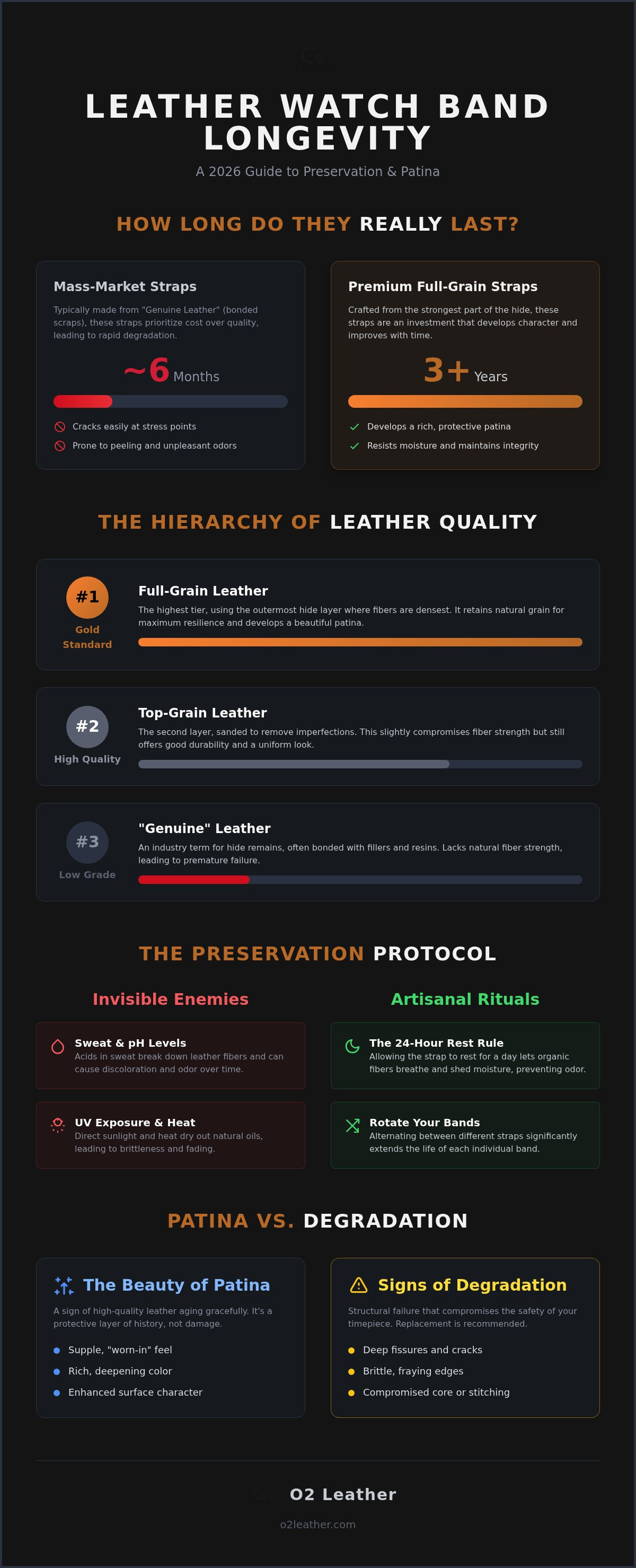
A leather strap is a living accessory. It responds to your heat, your movements, and your environment. When asking how long do leather watch bands last, the answer isn't a single date on a calendar. It's a spectrum. For most, the journey spans anywhere from six months to over three years. This variance depends entirely on the intersection of material integrity and daily habits. A strap isn't a static object. It's an organic component that breathes and ages alongside you.
The 6-Month vs. 3-Year Divide
Mass-market straps often rely on "genuine leather," a term that frequently masks lower-grade scraps bonded with synthetic adhesives. These bands typically fail within a single season. They crack at the buckle or peel at the edges because the underlying fibers lack natural strength. In contrast, artisan-tanned straps, like our Classic Bands, thrive in professional environments. Their endurance is bolstered by the specific Leather production and properties that define high-end hides. Longevity also benefits from a simple ritual: rotation. Wearing different bands allows organic fibers to shed moisture and rest, effectively extending their service life.
Patina: The Mark of a Long-Lasting Strap
True quality doesn't just endure; it improves. A premium strap develops a patina, a rich sheen formed by the absorption of natural oils and exposure to the elements. This isn't damage. It's a protective layer of history. You must distinguish between this aesthetic evolution and structural degradation. A "worn-in" strap feels supple and looks deep in color. A "worn-out" strap shows deep fissures, brittle edges, or a compromised core. Premium full-grain leather often looks more sophisticated at year two than it did on day one. This character is the hallmark of a strap designed for the long haul, rather than a fleeting trend.
Material choice remains the primary predictor of survival. While some competitors suggest leather is a disposable commodity meant for frequent replacement, the Modern Artisan knows better. By selecting a band with superior fiber density, you move away from the cycle of waste. You invest in a piece that tells a story. For those who value this level of detail across their entire wardrobe, brands like Cudworth provide the high-quality accessories needed to complement a well-maintained timepiece. Understanding the lifespan of your strap is the first step in mastering the art of the collection. Quality leather ages; it doesn't just fail. Your choice of material today dictates the story your watch tells three years from now.
The label "leather" is a broad umbrella covering everything from heirloom quality to industrial waste. When evaluating how long do leather watch bands last, you must look past the surface finish. The cellular structure of the hide dictates the strap's destiny. Most generic guides offer a flat estimate of twelve months, but this ignores the stark reality of leather grades. A full-grain band is a multi-year companion. A genuine leather strap is a temporary placeholder. The grade of leather you choose determines whether your accessory survives 200 wear-cycles or well over 1,000.
- Full-grain: The highest tier, utilizing the outermost layer of the hide where fibers are densest.
- Top-grain: The second layer, sanded to remove imperfections, which slightly compromises structural strength.
- Genuine leather: An industry term for the remains of the hide after higher tiers are removed, often bonded with fillers and resins.
Full-Grain: The Heritage Choice
Full-grain leather retains the skin's natural grain. This isn't just for aesthetics. These intact fibers provide the necessary resilience to withstand the constant tension of a buckle. While other materials stretch and warp, full-grain maintains its form. It resists moisture better than split leathers because the natural pores aren't ground away. This density allows it to absorb the oils from your skin, creating a patina that actually strengthens the surface over time. You can Explore our Classic Full-Grain Bands to see how this material translates into a refined, durable accessory.
The Vulnerability of Bonded and Patent Leathers
Bonded leather is the fast fashion of the watch world. It consists of shredded leather scraps glued to a polyurethane backing. Under UV exposure or simple daily friction, these chemical bonds fail. This leads to the unsightly peeling often mistaken for natural wear. Patent leather faces a similar fate. Its high-shine plastic coating is brittle. It's prone to cracking at high-stress points like the buckle holes. These materials aren't designed for longevity. They are designed for the shelf. If you want a strap that mirrors the quality of your timepiece, browse our curated leather straps for a more resilient alternative.
Material integrity is the foundation of endurance. By understanding the hierarchy of hides, you can avoid the "genuine leather" trap and invest in a piece that grows more beautiful with every wear. Your wrist deserves a material that respects the craft.
External Forces: Why Your Lifestyle Dictates Strap Survival
Material integrity provides the foundation, but your environment is the architect of decay. Heat, humidity, and the chemical composition of your skin determine the pace of aging. While a strap kept in a climate-controlled office may thrive for years, the same band worn in high-humidity environments faces a different reality. Moisture causes organic fibers to swell and contract. This constant internal movement eventually weakens the structure. UV rays act as a silent bleaching agent, stripping away natural oils and leaving the surface brittle. When assessing how long do leather watch bands last, you must first audit your daily surroundings.
The Active Wearer’s Dilemma
Sweat is more than simple moisture. It is a complex cocktail of salts and acids. As perspiration evaporates, microscopic salt crystals remain trapped within the leather’s pores. These shards act like internal sandpaper, grinding against the fibers with every wrist movement. This is the primary cause of the unpleasant odors and "stiffening" that plague daily-wear straps. High-intensity lifestyles demand a specialized solution. Our Water-Resistant Artisanal Bands utilize advanced tanning techniques to repel liquids, preventing salt saturation. For those who prioritize airflow, Rally style bands offer the breathability necessary to keep the underside of the strap dry and structural integrity intact.
Tech and Friction: The Modern Stressors
Modern professional life introduces a mechanical stressor often overlooked by traditional guides: the desk. Resting your wrist on a hard surface for eight or more hours a day creates constant, abrasive friction. This contact slowly thins the leather and compromises the edge paint, leading to premature fraying. You can mitigate this damage by curating your workspace. Integrating a premium leather deskmat provides a soft, low-friction landing for your timepiece. This simple shift reduces the physical toll on your strap significantly. Our analysis of Leather Desk Mat vs Wood: Elevating the Interface explores how these artisanal surfaces work in tandem with your accessories to preserve their character. By protecting the band from hard-surface friction, you ensure that the only marks it carries are the ones you choose to give it.
Ultimately, longevity is a reflection of how you navigate the world. A strap is a tool, but even the finest tools require a mindful environment to reach their full potential. Understanding these external forces allows you to adapt your care ritual before the damage becomes irreversible.
The Preservation Protocol: Maximizing Your Band’s Character
Longevity is a choice. While material quality sets the ceiling, your maintenance ritual determines how quickly you reach it. Leather is an organic, porous material. It requires a rhythm of rest and nourishment to maintain its structural integrity. The most effective way to extend the question of how long do leather watch bands last is the 24-hour rest rule. Never wear the same strap two days in a row. This gap allows the fibers to release accumulated moisture and return to their natural shape. Without this pause, the leather remains saturated. This leads to structural softening and premature failure.
A Step-by-Step Cleaning Ritual
Cleaning should be proactive. If you wait for a visible stain, you've waited too long. Oils and salts become permanent fixtures in the grain if left unaddressed. Follow this three-step ritual monthly to preserve the leather's surface.
- The Dry Brush: Use a soft-bristled brush to sweep away dust and micro-particulates. If left alone, these particles act as abrasives that grind into the finish with every movement.
- The pH-Balanced Wipe: Use a specialized leather cleaner or a lightly dampened cloth with mild, pH-neutral soap. This clears away the salts discussed in previous sections without stripping the essential oils.
- The Air-Dry: Patience is mandatory. Let the strap dry naturally at room temperature. Never use a hairdryer or rest it on a radiator. Forced heat causes the fibers to shrink and snap.
Conditioning for Suppleness
Conditioning is the art of restoring what time and wear take away. You can identify when your strap is thirsty using the flex test. Gently bend the band. If the color lightens significantly or the surface feels stiff, the fibers are parched. Use a high-quality leather balm rather than heavy waxes. Waxes create a superficial seal that clogs pores. This prevents the leather from breathing. Proper conditioning ensures the fibers remain lubricated and slide against each other without friction. This prevents the deep fissures and snapping that often plague neglected straps. By keeping the material supple, you effectively double the answer to how long do leather watch bands last.
Proper storage is the final pillar of preservation. Avoid leaving your timepiece in direct sunlight or near high-heat sources. These environments accelerate dry rot, a state where the leather becomes irreparably brittle. When your strap isn't on your wrist, it should rest in a cool, ventilated space. If you're ready to start your collection with materials that respond beautifully to this care, shop our artisanal leather straps to find your next heirloom.
Recognizing the End: When to Refresh Your Aesthetic
Even the most cherished patina eventually meets its threshold. Understanding how long do leather watch bands last requires an honest assessment of structural safety. A strap isn't just a style choice. It's the only thing keeping your timepiece on your wrist. When the leather moves from "aged" to "compromised," especially on high-value timepieces like those curated by Watch Capital, the risk of losing your watch outweighs the desire to keep a vintage look. This point of no return is often subtle. It begins with microscopic fatigue. It ends with a broken spring bar connection. Knowing when to retire a band is as much an art as the preservation itself.
Terminal Signs of Failure
Identify the signals that care can no longer fix. Deep cracking at the spring bar holes is the most critical warning. These points bear the constant tension of the watch lugs. If you see fissures here, the material has lost its load-bearing capacity. Lining separation is another terminal sign. If the inner and outer layers delaminate beyond repair, moisture traps between them. This causes the internal structure to rot from the inside out. Finally, address persistent odors. If a professional cleaning ritual doesn't remove the scent, bacteria have colonized the deep fibers. At this stage, the strap is no longer a premium accessory. It is a hygiene liability.
Curating Your Next Chapter
Replacing a strap is an opportunity for reinvention. A fresh band can revive a watch you haven't worn in months. It shifts the entire narrative of the piece. You might transition from a rugged aesthetic to something more architectural. Our 2026 Guide to Premium Craftsmanship offers deep insights into matching your next selection to your current lifestyle. If your daily routine has shifted toward a more minimalist tech aesthetic, an Ultra-Slim Band provides a streamlined profile for your next year of wear. It offers a lighter feel without sacrificing the artisanal quality you expect.
Longevity is about the journey, but every journey has a conclusion. By recognizing these terminal signs, you protect your investment and maintain your standard of style. When you're ready to begin the cycle again, Explore the O2 Leather Watch Band Collection. Choose a material that respects the history of your timepiece while embracing the future of your personal collection. Every new strap is a chance to redefine your wrist's character.
Begin Your Journey of Character and Craft
The evolution of your watch strap is a direct reflection of your lifestyle. We've explored how material integrity and intentional care redefine the standard expectations of how long do leather watch bands last. By choosing full-grain hides and respecting the 24-hour rest rule, you transform a simple accessory into a lasting companion. Quality isn't a static trait. It's a lived experience that rewards the mindful wearer.
Our collection is built for this endurance. We source premium full-grain leather specifically for its ability to develop a unique, heritage patina over time. For those with active tech-wear needs, our specialized water-resistant options ensure your style survives the elements without compromise. Whether you prefer a classic profile or a modern rally aesthetic, your choice today sets the stage for years of sophisticated wear. It's time to break the cycle of disposable accessories.
Elevate your timepiece with our artisanal leather collection.
Your timepiece deserves a partner that ages with grace. Embrace the ritual of the Modern Artisan and let your strap tell a story worth keeping. We look forward to seeing how your collection evolves.
Frequently Asked Questions
How often should I replace my leather watch band?
You should replace your band when structural integrity is compromised, typically every one to three years for high-quality leather. Look for deep cracks at spring bar holes or lining separation. While aesthetic patina is desirable, physical degradation puts your timepiece at risk. Regular rotation and maintenance extend this timeline. If the leather becomes brittle or develops persistent odors that resist cleaning, it's time to refresh your aesthetic with a new artisanal strap.
Can I wear a leather watch band every day?
You can wear a leather band daily, but doing so significantly shortens its lifespan. Organic fibers need time to shed moisture and return to their natural shape. Constant exposure to skin oils and sweat leads to faster fiber breakdown. We recommend the 24-hour rest rule. By rotating between two or more bands, you allow the materials to breathe, effectively doubling how long do leather watch bands last compared to single-strap daily use.
How do I stop my leather watch strap from smelling?
Prevention is the most effective solution for odors. Regularly wipe the underside of the strap with a pH-balanced cloth to remove salts and skin cells before they embed. Avoid wearing the band during high-intensity activities where heavy perspiration occurs. If an odor develops, use a specialized leather cleaner. Never use harsh household chemicals. Allowing the strap to air-dry completely between wears prevents the bacterial growth responsible for the unpleasant scents often found in neglected straps.
Is it okay to get a leather watch band wet?
Occasional splashes are acceptable, but standard leather should never be submerged. Water strips natural oils, causing the fibers to become brittle upon drying. If your strap gets wet, pat it dry immediately and let it air-dry at room temperature. Avoid direct heat sources like hair dryers. For those with active lifestyles, our specialized Water Resistant Bands provide the necessary protection against moisture while maintaining the premium look and feel of traditional, high-end artisanal leather.
Why does my leather watch strap crack near the buckle?
Cracking occurs due to mechanical stress combined with fiber dehydration. The buckle is a high-pressure point where the leather is repeatedly flexed and pulled. If the material isn't regularly conditioned, the internal fibers become stiff and snap under this tension. Using a high-quality leather balm keeps the strap supple. This allows the material to bend without fracturing. Lower-grade leathers, like bonded or genuine varieties, are especially prone to this type of structural and aesthetic failure.
Does the quality of leather affect how long a watch band lasts?
Leather quality is the primary factor in determining endurance. Full-grain leather utilizes the densest part of the hide, offering superior resistance to stretching and tearing. Lower grades, such as genuine leather, are made from weaker split layers bonded with adhesives. These materials lack the structural integrity to withstand daily wear-cycles. Understanding these grades helps you predict how long do leather watch bands last. Investing in premium materials ensures your strap ages gracefully into a rich patina rather than peeling.
How can I tell if my leather watch band is high quality?
High-quality leather is identified by its scent, texture, and grain. Premium full-grain bands possess a rich, earthy aroma rather than a chemical smell. Look for natural imperfections in the grain, which indicate the surface hasn't been sanded down or corrected. The edges should be cleanly finished, and the strap should feel substantial yet flexible. Quality leather develops a patina over time. It doesn't peel or show synthetic layers when flexed or lightly scratched by daily use.
Can I exercise with a leather watch band?
Standard leather bands are not designed for the rigors of heavy exercise. Sweat contains salts and acids that crystallize within the pores, causing the leather to rot and crack. If you maintain an active lifestyle, choose our Water Resistant Bands or Rally Bands with perforated designs for better breathability. These specialized styles are engineered to handle moisture while providing the sophisticated look of leather. Always wipe your strap down with a dry cloth after any physical activity.